

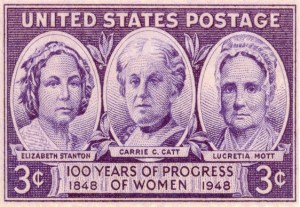
Ask anyone who knows me, I’ve been vocal about voting before I was allowed to vote. I do not take lightly that as Americans we have this power to decide who represents us on a local, state, and national level. Even more, I’ve always been moved by the godmothers of the women’s right to vote (suffrage), Elizabeth Cady Stanton and Susan B. Anthony.
170 years ago, the leader of the American Suffragette Movement, Elizabeth Cady Stanton organized a women’s convention that over 300 women attended in Seneca, NY about this crazy notion that women should be allowed to vote.
Women, go vote. Independent, Democrat, Republican: vote. Women were jailed so you could vote. Do it for them. Feminist is not a bad word. You don’t have to wear a pussy hat. You don’t have to stand outside of a polling place and yell. Just vote.
In case you’d like to learn a little more, this is part of Stanton’s biography from Mrs. Nussbaum.com
Elizabeth Cady was born in Johnstown, New York on November 12, 1815. She was the eighth of 11 children. Her father was a lawyer, a state assemblyman, and a congressman. She went to school at the Johnstown Academy and Emma Willard’s Troy Female Seminary. She studied Latin, Greek, mathematics, religion, science, and French. The law was often discussed at home, and she learned that married women at that time had virtually no right to property, income, employment, or even custody rights over their own children. Slavery did not end in New York until 1827, and Stanton’s father was a slaveowner. Peter Teabout took care of Stanton and her sister Margaret.
After finishing school, she occupied herself with the usual activities of a wealthy daughter. This included visits to relatives. She met Henry Brewster Stanton, an abolitionist orator in 1839 when she visited her cousin. They married in 1840. They socialized with Frederick Douglass, William Lloyd Garrison, Louisa May Alcott, and Ralph Waldo Emerson. The Stantons had seven children. She raised them almost on her own because Henry was busy with law studies and reform activities.
Elizabeth Cady Stanton became friends with Angelina Grimké, Sarah Grimké, Lucretia Mott and other reformers. In 1847, Elizabeth moved to Seneca Falls, New York. The next year, she organized a women’s rights convention there. Over 300 people attended. Her Declaration of Sentiments, declared that men and women are created equal and that women should have the right to vote. It also called for an end to women’s taxation without representation and government without women’s consent. Some delegates were against the idea of suffrage for women (the right to vote). Elizabeth said that Frederick Douglass helped her to convince a majority to support the idea. Women in other states learned of the convention in New York. Petitions for property rights and suffrage were started in other states and more conventions were held.
Elizabeth wrote articles and letters calling for a woman’s right to go to medical school; wear short hair and more comfortable clothing; to write novels and take jobs of their choice. She advocated that a married woman had a right to her own property and to earn wages. She thought women should have a legal right to leave an abusive marriage and to decide with whom and when to have children.
In 1851, she met Susan B. Anthony, who was active in the movement to ban alcohol. Together they made New York a center for women’s rights activities. In 1860, due to their efforts, laws regarding the economic rights of married women, the custody rights of mothers, and equal rights for widows were revised in New York.
In 1864, Stanton and Anthony organized the collection of 400,000 signatures in support of the emancipation of slaves. Elizabeth did not, however, support the Fourteenth and Fifteenth Amendments to the United States Constitution. She did not think it was right to give more legal protection and voting rights to African American men when women of all races did not have the same rights. Other leaders in the women’s rights movement (Lucy Stone, Elizabeth Blackwell, and Julia Ward Howe) argued against Stanton’s position. After the Fourteenth and Fifteenth Amendments were ratified, Elizabeth and others began to argue that these amendments actually gave women the right to vote. Anthony (in 1872), Stanton (in 1880), and many others went to the polls and demanded to vote.
Stanton died of heart failure in New York City on October 26, 1902. This was 18 years before women in the United States were granted the right to vote in 1920. The Elizabeth Cady Stanton House in Seneca Falls was declared a National Historic Landmark in 1965.
 kerryfaler.blog